
Your external legal spend is the budget for agents

The services line item that enterprise legal teams are starting to reallocate. Jake Jones explains.
⚡ The budget you already have
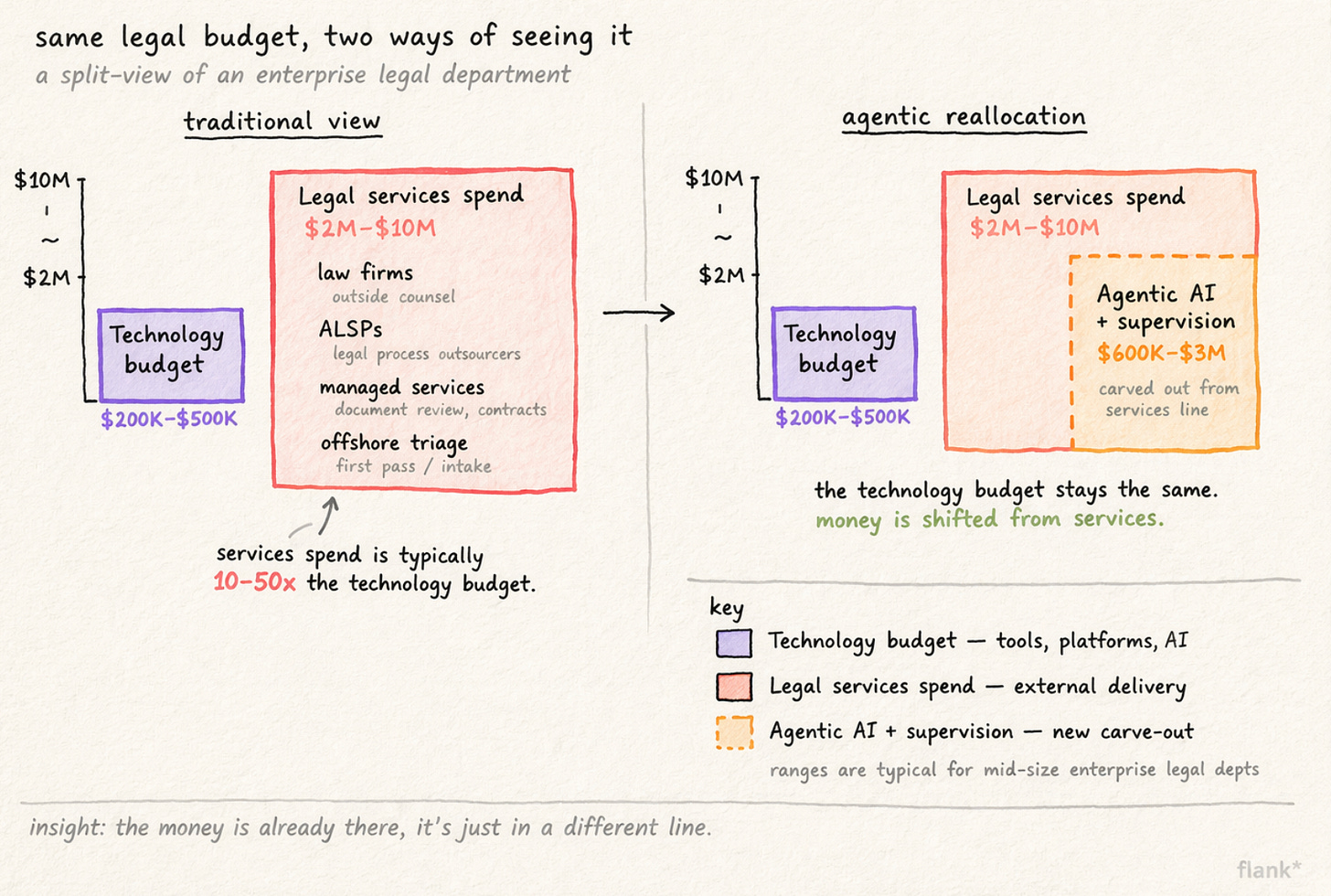
Most enterprise legal teams I speak to are sitting on a budget for agentic AI that they have not yet recognised as such. It is not in their technology line item. It is in their services spend: the law firms handling routine contracting, the ALSP running procurement review, the offshore team doing first-pass triage, the managed service provider processing NDAs.
In my experience, that services spend typically runs somewhere between ten and fifty times larger than the technology budget in large enterprises, though the ratio varies enormously by industry and by how much a given GC has historically relied on outside counsel. The point is not the precise multiple. The point is that when you start looking at where agentic deployments actually get funded, it is almost never the technology line. It is the services line. And I think this tells you something important about where the market is heading.
The reallocation that is already happening
A legal ops leader at a Fortune 500 insurance company walked me through his cost base last week: $500,000 a year on consultants, $200,000 on CLM licences, $40,000 on e-signature tooling. He had calculated, almost casually, that if he could shift a portion of that into agentic workflows he could hand his CLO $900,000 back in a single conversation. What struck me was not the number but the framing. He was not asking for new budget. He was looking at money he already spent and asking whether the thing it was being spent on could now be done differently.
A global hospitality company reached the same conclusion from a different direction. Their lawyers were spending the bulk of their time on franchise agreement renewals, work that followed established patterns and internal playbooks but consumed enormous capacity because there was just so much of it. They figured out that two or three lawyers supervising agents could cover the output that previously required a team of forty. I want to be careful here because these are early examples and I am not claiming this is proven at scale. But the pattern is consistent enough that I think it is worth taking seriously: teams are not starting with a technology procurement process. They are starting by looking at their services spend and asking which portion was buying expertise and which was buying labour on repeatable tasks.
He was not asking for new budget. He was looking at money he already spent and asking whether the thing it was being spent on could now be done differently.
🔍 The structural squeeze that makes this urgent
The CLOC 2026 State of the Industry Report, published earlier this month, puts numbers to something that most legal ops leaders already feel in their bones. Demand is surging in complex areas, regulatory compliance, cybersecurity, all the things that actually require experienced lawyers. But budget and headcount growth have flattened. Only 37% of legal departments expect to increase outside counsel spend this year, down from 58% the year before. And 65% reported making intentional efforts to keep work in-house over the last one to two years.
For years, the default response to rising demand was to send more work out. That is becoming harder to justify, both economically and politically within the organisation. Legal departments are being asked to absorb more complexity without proportional increases in either people or external spend, and the question of how to do that is not theoretical anymore. It is the quarterly planning conversation.
Only 37% of legal departments expect to increase outside counsel spend this year, down from 58% the year before. And 65% reported making intentional efforts to keep work in-house over the last one to two years.
I think this is the context that makes the agent conversation urgent in a way it was not twelve months ago. It is not really about whether agents are interesting technology. It is about whether your team can absorb what is coming without either grinding your lawyers into the ground or writing larger and larger cheques to law firms for work that, if you are being honest, probably does not require a £400-per-hour associate.
Why copilots have not solved this
I have written about this elsewhere (see The throughput problem nobody is measuring) so I will not belabour the point, but the short version is: copilots make individual lawyers faster without changing how many requests the team can process concurrently. If the reason work goes to outside counsel is that your team literally cannot absorb it, making each lawyer 25% quicker does not solve the problem. You need more capacity, not more speed. Agents add capacity that is decoupled from headcount, which is why teams that deploy them are able to bring work back in-house in a way that copilots never quite delivered on.
You need more capacity, not more speed.
🏗️ What “outsource to agents” actually means in practice
I want to be specific about what this model looks like, because “agentic AI” has become broad enough to mean almost anything and I find the vagueness actively unhelpful.
The model gaining traction works like this. You pick two or three high-volume contracting workflows that currently eat a lot of lawyer time or external spend. You deploy agents that sit in whatever channel those requests arrive through, usually a shared Outlook mailbox, sometimes a CLM or ticketing system. The agent picks up requests as they come in, processes them against your playbooks and templates, and routes completed work to a supervision queue. A lawyer reviews exceptions, checks the flagged items, approves or adjusts. Everything else is handled and sent without a lawyer touching it.
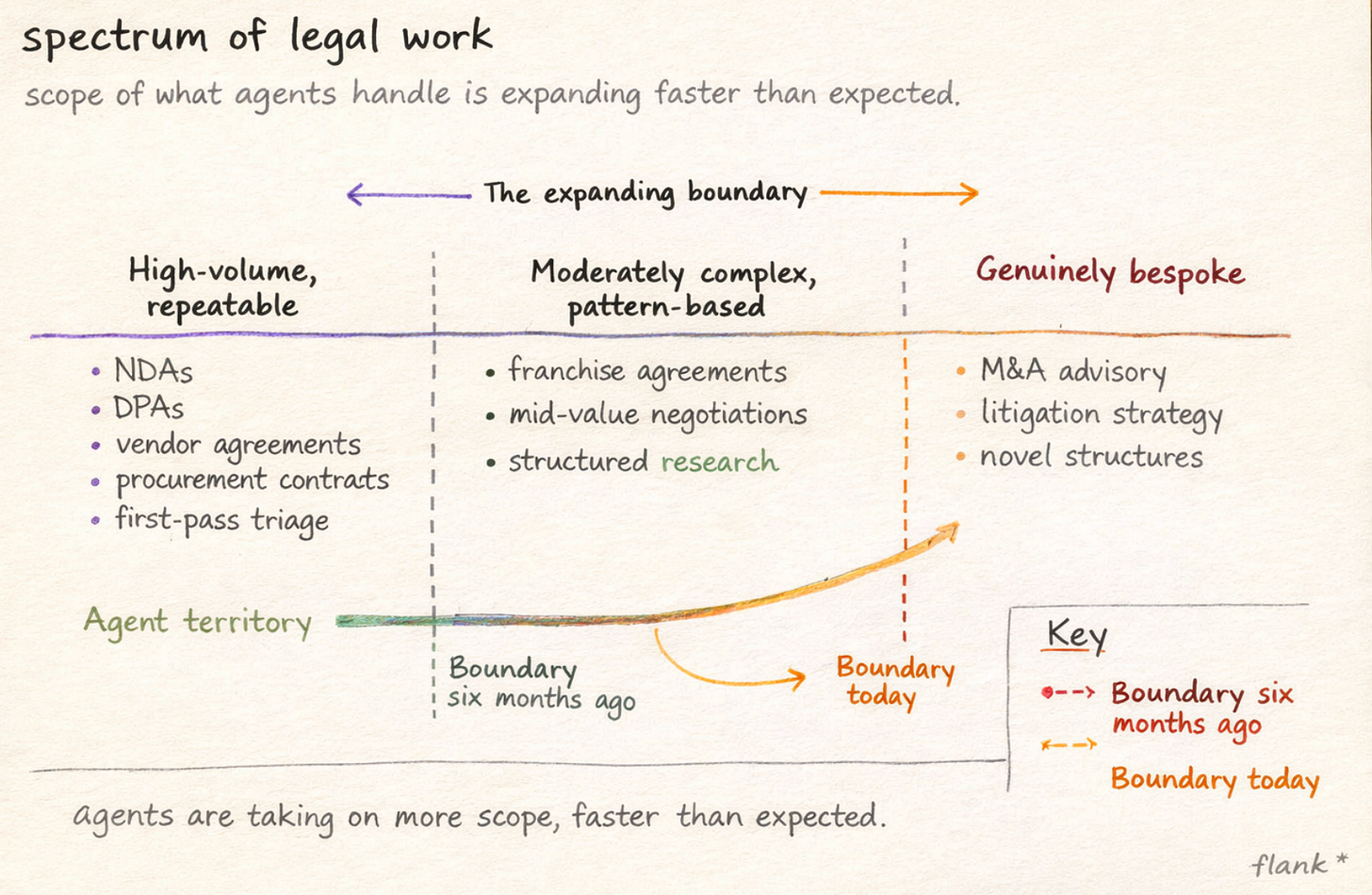
✳️ The key distinction from a copilot is that no lawyer initiates the work. The agent operates asynchronously. Requests that arrive at 2am get processed at 2am. End-of-quarter spikes do not create a backlog because the agent’s throughput is not bounded by how many people are available.
The supervision piece is what makes this viable for legal work, and I think it gets less attention than it deserves. The teams I see adopting this successfully are not deploying agents unsupervised. They are designing a new layer in their operating model: designated supervisors whose job is to check agent output, correct edge cases, and feed improvements back into the system. Some teams are repurposing existing paralegals into this role. Others are creating it as a distinct function. A consulting partner I spoke to recently described the same pattern from the advisory side: agents execute, one or two experienced lawyers supervise, everyone else focuses on work that genuinely requires human judgment.
The teams I see adopting this successfully are not deploying agents unsupervised. They are designing a new layer in their operating model.
I find this less radical than it might initially sound, which is part of why I think it works. A law firm running your NDA programme has a partner who supervises, associates who do the work, trainees who handle the operational setup. The agentic model preserves exactly that hierarchy. The supervision function stays human. The execution layer shifts from people to agents. What changes is the cost structure, not the professional logic.
How to evaluate where this applies in your organisation
Not all external legal spend is equally vulnerable to this shift, and I think being honest about the boundaries matters more than overselling the scope.
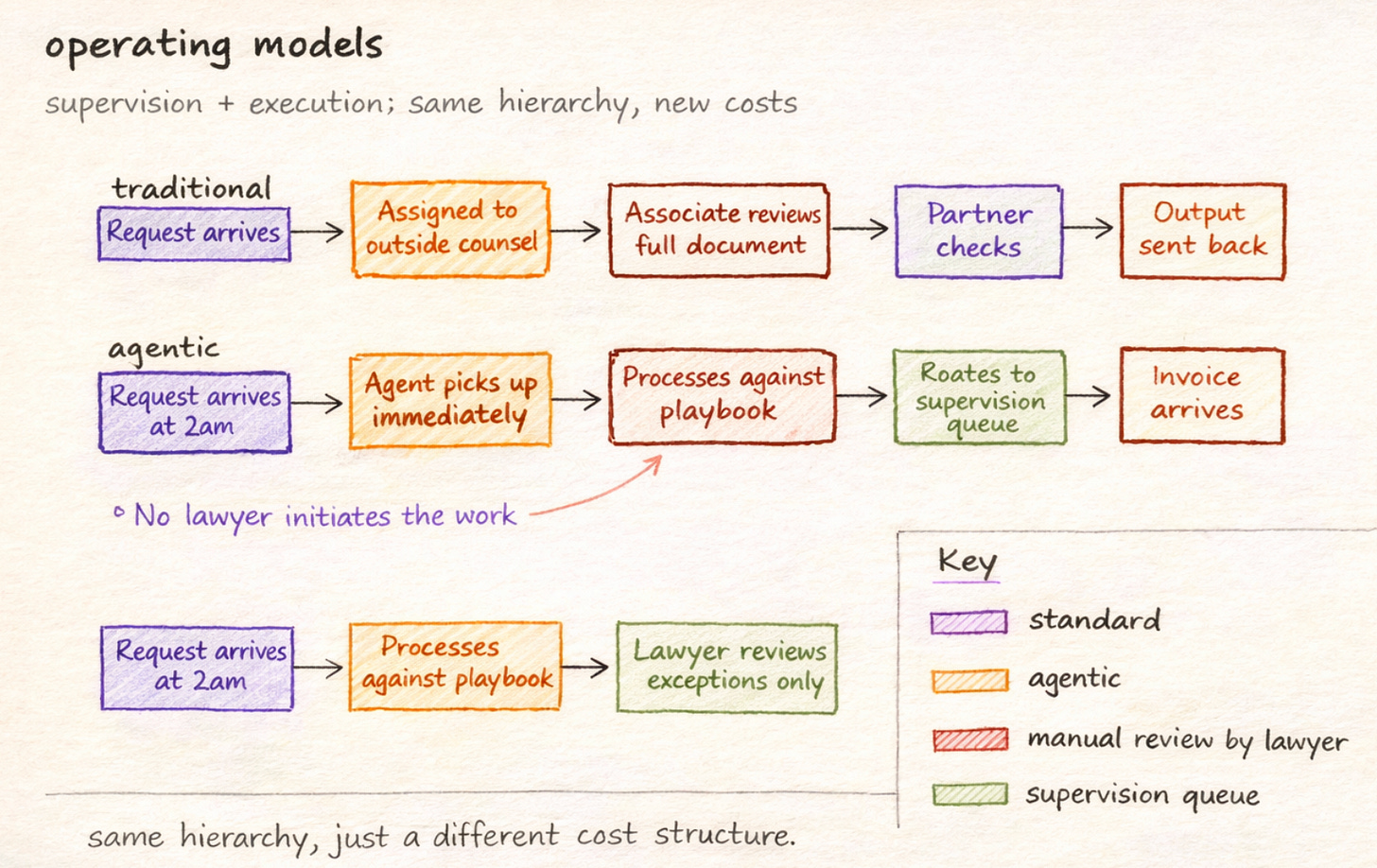
The work that agents handle well today is high-volume, lower-to-mid complexity, and governed by established rules or playbooks: NDAs, DPAs, vendor agreements under a certain value threshold, standard procurement contracts, routine employment documents, franchise renewals, first-pass triage and routing. If you currently outsource this work to a law firm or managed service provider, or if it consumes a disproportionate share of your internal team’s time, it is worth evaluating whether an agent could handle it under internal supervision.
The work that agents handle well today is high-volume, lower-to-mid complexity, and governed by established rules or playbooks.
The work that should stay with specialist firms is genuinely bespoke. Complex M&A advisory, high-stakes regulatory guidance, novel commercial structures, litigation strategy. This is work where you are buying judgment and experience, not labour on a repeatable task. I do not think agents are close to displacing this, and I would be sceptical of anyone who claims otherwise.
The interesting middle ground, and this is where I keep changing my mind, is work that sits between those two categories. Moderately complex contracts that follow patterns but require some judgment calls. Negotiations where the agent handles the first three rounds and escalates the difficult positions. Research tasks where the agent assembles the raw analysis and a lawyer shapes the conclusion. The boundary of what agents can handle competently is moving outward faster than I expected. Six months ago, a 150-page franchise agreement would have been firmly in the “too complex” category. Today I see agents processing these with a supervision check that takes a fraction of the time the full manual review required. I am not confident I know where this boundary will be in another six months.
The boundary of what agents can handle competently is moving outward faster than I expected.
For any GC or legal ops leader trying to scope this, I would suggest a concrete exercise. Take your external legal spend from the last twelve months and categorise it: which engagements were buying expertise you do not have internally, and which were buying capacity you could not staff for? The second category is your target.
The law firm question that is becoming harder to avoid
Gartner’s research shows that only 20% of legal matters sent to outside counsel stay within the planned budget range. I keep coming back to that number because it suggests something beyond just poor budgeting. It suggests that a lot of outside counsel spend is not planned so much as absorbed, the inevitable consequence of a team that does not have capacity to do the work itself, sending it to whoever can pick it up fastest regardless of cost.
A law firm that was spending two hours on a task that an agent can now handle in fifteen minutes of supervision time will face pressure from one direction or another. Either you demand lower fees, or the firm absorbs the efficiency gains without telling you. Either way, the cost comparison with an agentic alternative supervised by your own team is going to get harder to avoid.
A law firm that was spending two hours on a task that an agent can now handle in fifteen minutes of supervision time will face pressure from one direction or another.
I think the teams that navigate this well will be those that audit their external spend now, before the market forces their hand, and get precise about which relationships are buying strategic value and which are buying commodity labour at premium rates. That is not an argument against outside counsel. It is an argument for knowing what you are actually paying for, which is a conversation that a surprising number of legal departments have not had rigorously.
The timeline question
I do not know how fast this plays out at scale. I want to be straightforward about that. The gap between a compelling demonstration and a production deployment is real, and it is filled with things that are individually boring but collectively slow: playbook configuration, supervision design, integration work, the organisational change management that nobody wants to talk about but everyone encounters. The CLOC data showing that 85% of legal departments now have dedicated AI oversight or resources suggests the governance infrastructure is being built, but governance is necessary and not sufficient. It does not put agents into production.
What I do see is that the teams moving first are not waiting for certainty. They are starting with one or two workflows, building the supervision model, learning what works, and expanding from there. The advantage they are building is not just cost savings but something more durable: codified playbooks, agents that carry institutional knowledge, and a team that has figured out how to operate in a world where agents do the volume work and lawyers do the thinking. That institutional capability compounds. The team that starts now will be meaningfully ahead of the team that starts in eighteen months, not because the technology will be worse in eighteen months, but because the organisational learning takes time that cannot be compressed.
If you are a GC or legal ops leader and you have not yet looked at your services spend through this lens, I would encourage you to do so. Not because I think you need to move tomorrow, but because the exercise itself is clarifying. You will probably find, as most of the teams I speak to find, that a meaningful share of what you spend on external legal services is not really buying legal expertise. It is buying throughput. And throughput is exactly the problem that agents are built to solve.
The team that starts now will be meaningfully ahead of the team that starts in eighteen months, not because the technology will be worse in eighteen months, but because the organisational learning takes time that cannot be compressed.
📌 Further reading
A few things I have been reading that informed the thinking above, and that I think are worth your time if any of this resonated.
CLOC 2026 State of the Industry Report — The primary data source for the structural squeeze I describe in this post. The headline numbers (37% expecting OC spend increases, down from 58%) are striking, but the deeper story is in the framing: CLOC explicitly describes outside counsel as a “release valve” that is closing. Worth reading in full if you run legal ops.
2026 Report on the State of the US Legal Market (Thomson Reuters / Georgetown Law) — The best analysis I have seen of the tension between record law firm profitability and the structural instability underneath it. The finding that 90% of legal revenue is still billed hourly while AI compresses the hours is the kind of contradiction that does not resolve quietly. Legal IT Insider’s summary is excellent.
Legal AI is splitting in two, and most people miss the difference (Fortune) — Written by someone at Thomson Reuters, so read it with that in mind, but the “authoritative AI vs operational AI” framing is genuinely useful. The work I discuss in this post sits firmly on the operational side: executing contracts, processing requests, routing work. The authoritative layer, case law, regulatory research, jurisdiction-specific guidance, is a different problem with different economics.
McKinsey’s CEO on 25,000 AI agents (Fortune) — Not legal-specific, but I think this is the single most important data point about where professional services are heading. McKinsey went from 3,000 to 25,000 agents in eighteen months, saved 1.5 million hours in a year, and is shifting to outcome-based pricing. The “25 squared” model, growing client-facing roles by 25% while shrinking non-client-facing roles by 25%, is a preview of what legal departments will do. Replace “consultant” with “lawyer” and the structure is identical.
Ten AI predictions for 2026: what leading analysts say legal teams should expect (National Law Review) — A useful roundup of Gartner, Forrester, and McKinsey predictions for legal AI, compiled by Jones Walker. Particularly worth reading for the governance section: EU AI Act obligations hit in August 2026, and Colorado’s AI Act takes effect in June. If you have not started thinking about compliance, you are behind.
✳️
Learn what is possible with agents at flank.ai.